Paragraph Formatting
A paragraph is a unit of text or other content that begins at the start of a document, right after a hard return (a carriage return), a page break, or section break, or at the start of a table cell, header, footer, or list of footnotes and finishes with a hard return (carriage return) or at the end of a table cell. Word documents usually have paragraphs that are differently formatted. Even a very basic document with a centered title and a justified body has paragraphs with two otherwise different types of formatting.
Word’s graphical user interface (GUI) offers methods of applying many formatting options to your paragraphs. But these options are not all in one place, and some of these places vary from one version of Word to another. This is the reason this page has been split into the following sections, and the relevant options are detailed in each section.
The Paragraph Group
There are numerous choices immediately available in the Paragraph group on the Home tab of the Ribbon, in the Paragraph group on the Page Layout tab, and on the contextual toolbar and menu that will come up when you right-click in text.
Alignment
Alignment or justification is the method by which the lines of a paragraph are aligned. Four types of alignment exist, and the highlighted button in the Paragraph group on the Home tab indicates the type of alignment of the paragraph at which your cursor is pointing
Alignment

Alignment or justification is a method by which the lines of a paragraph are aligned. Alignment is of four different kinds, and the kind of alignment of the paragraph where your cursor is placed is shown in the highlighted button in the Paragraph group in the Home tab.
home tab paragraph group
- With left alignment ( ) (the default), the left-hand ends of all the lines in the paragraph are aligned along the left-hand margin of the text area.
• With center alignment, the mid-points or centers of all the lines in the paragraph align along the same imaginary vertical line at the center of the text area between the margins.
• With right alignment, the right-hand ends of all the lines in the paragraph are aligned along the right-hand margin of the text area.
- With justified alignment or full justification ( ), all the lines in the paragraph, except the last line, are extended so that the left-hand end of each line is aligned along the left-hand margin of the text area, the right-hand end of each line is aligned along the right-hand margin of the text area, and the lines are all of the same length. This is achieved by inserting additional space between words.
You can set the type of alignment of the paragraph in which your cursor is positioned, or of several selected paragraphs, by clicking the applicable button in the Paragraph group on the Home tab. You also can set the type of alignment via shortcut keys (see table in Keyboard Shortcuts below).
Note. When you apply justified alignment to a paragraph, the last line does not extend across the full width of the text area. You can make all the lines in a paragraph extend across the full width of the text area by placing your cursor within the paragraph and pressing Ctrl+Shift+J, but it should be mentioned that in this case Word also adds space between letters within words to extend the lines.
Line Spacing

Line spacing is the vertical distance between the lines within a paragraph, and it determines the point at which each line of text will be located relative to the line above it. Spacing can be expressed by name such as single, 1.5 lines, double; as a numeric value representing a multiple of single line spacing, such as 2.0 (which is equivalent to double spacing); and as an exact measurement in points (pt), where one point equals 1/72 inch. You can see and change line spacing rapidly using the Line Spacing button in the Paragraph group on the Home tab. Clicking Line Spacing Options opens the Paragraph dialog box shown below, where you have access to more spacing options
Note. If the first of two consecutive paragraphs has non-zero spacing after it and the second paragraph has non-zero spacing before it, only the larger of the two spaces will be inserted between the paragraphs.
Line spacing determines how much vertical distance is placed between lines of text within a paragraph and dictates the placement of each line relative to the previous one. The following types of line spacing can be set in the Line spacing box:
• Alone
• 1.5 lines
• Twofold
Indents

- At least. When this option is selected, an exact distance in points – in which a point (pt) is 1/72 of an inch – is specified in the At box.
- Exact. When this option is selected, an exact distance in points, where a point pt is a unit of length equal to 1/72 of an inch, is specified in the At box.
- Multiple: When this is chosen, a number, representing a multiple of single spacing (for instance, 2.0 is equal to double spacing), is entered in the At box.
Line and Page Breaks Tab
You can set the paragraph formatting options on the Line and Page Breaks tab of the Paragraph dialog box to help you control where automatic page breaks occur in your document.
Paragraph Spacing

The spacing between your paragraphs is determined by the spacing before it and the spacing after it that are set for each paragraph. You can change the spacing before a paragraph and the spacing after it by changing the values in the applicable boxes in the Paragraph group on the Page Layout tab.
Note. If the first of two consecutive paragraphs has non-zero spacing after it and the second paragraph has non-zero spacing before it, only the larger of the two spaces will be inserted between the paragraphs.
Borders

To add borders around the paragraph where your cursor is located, click the Borders button (Borders) to insert the currently default borders (the original default or the last border style you chose). To choose a border style that’s different from the current default, click the arrow to the right of the Borders button, and choose one of the border styles that’s shown, or click Borders and Shading to design your own custom border. To add borders around multiple paragraphs, first select the paragraphs to which you want to add borders before you click the Borders button or its arrow.
Shading

(Colored Background)
To apply shading using the current default background color to all the text area in the paragraph in which your cursor is placed, click Shading in the Paragraph group on the Home tab. Alternatively, if you wish to choose a background color other than the current default color, click the small arrow on the Shading button then click one of the colors shown or define your own custom color. If you want to give multiple paragraphs the same type of shading, select the relevant paragraphs before clicking the Shading button or the small arrow on it.
If you select a very dark background color, for instance, Word will automatically change your text color to white to keep your text visible with good contrast.
The Paragraph Dialog Box

Many of the paragraph formatting options described in the previous sections, as well as additional paragraph formatting options, are available on the Paragraph dialog box, which has two tabs.
Indents and Spacing
Line and Page Breaks
Before opening the Paragraph dialog box, position the cursor anywhere within a single paragraph that you want to format or select all of the multiple paragraphs that you want to format. To open the Paragraph dialog box, on the Home tab or on the Page Layout tab, at the bottom of the Paragraph group, click the Paragraph dialog box launcher
When you click OK in the Paragraph dialog box, or press Enter, any changes that you have made on either tab will be applied to the single paragraph where you cursor was located or to the paragraphs that you selected. The options available to you for paragraph formatting on the Indents and Spacing tab of the Paragraph dialog box are divided among the three groups: General, Indentation, and Spacing.
These paragraph formatting options are described in the following subsections.
The Tabs Dialog Box

You use tab stops to align horizontally portions of text or other content on one or more lines when those portions of text or other content in each line are separated by tab characters. As you set a tab stop, you can configure it to align text to the left of the tab stop position, to align text to the right of it, to center text at it, to align the decimal point in the text at it, or to add a solid vertical line or bar at the tab stop in front of the aligned text.
It is also possible to set, in addition, a tab stop leader in the form of a dotted line, a dashed line, or a solid line that extends from the text at the previous tab stop to the text aligned at a tab stop.
If you do not set any tab stops in a paragraph either directly or by applying a style to it, Word creates default tab stops every 0.5″ (1.27 cm) across the whole width of the text area. The tab stops that are configured in a paragraph apply to all the lines in the paragraph.
The Tabs dialog box is used to set tab stops for one or more paragraphs. Before opening the Tabs dialog box, place your cursor anywhere within a single paragraph for which you want to set tab stops or select the multiple paragraphs for which you want to create tab stops. Next open the Tabs dialog box as follows. First open the Paragraph dialog box as described in The Paragraph Dialog Box. Then in the Paragraph dialog box click Tabs.
To change the tab stops that appear in the Tabs dialog box for the single paragraph or multiple paragraphs that you selected, follow these steps:
If one or more tab stops are listed under Tab stop position, click Clear All to delete all of them, or select each tab stop that you want to delete and click Clear.
To insert a new tab stop, type its position in the Tab stop position text box, then under Alignment select the type of alignment you want, under Leader select None or the type of leader you want, and click Set.
The position of the new tab stop should appear under Tab stop position.
To set more than one tab stop, simply repeat the previous action for however many tab stops you need to set.
If you want to use evenly spaced default tab stops, once you have cleared any tab stops that may have been listed under Tab stop position, adjust the distance that appears in Default tab stops to the desired default spacing.
Click OK.
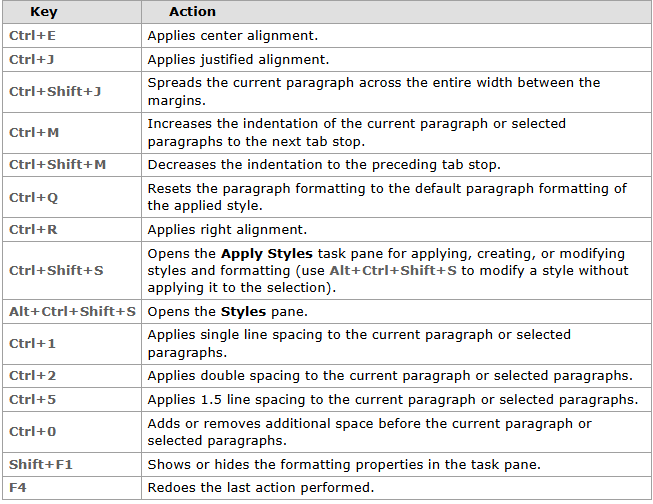
Keyboard Shortcuts
Keyboard shortcuts – or shortcut keys, or shortcut key combinations – that you can use to apply paragraph formatting quickly are included in the following table.
Keyboard shortcuts for use in paragraph formatting
. More Information
For more on line spacing, see Change the Default Line Spacing and Change the Line Spacing. For more on adjusting paragraph indents, see Adjust Indents and Spacing. For more on tabs, see the Microsoft help topic Set Tab Stops or Clear Them (for Word 2016) or Set, Edit, or Clear Tabs in Word
Great information garima ji